Monday, October 16, 2006

Fire Prevention Week

I have been very busy taking care of some changes that are coming on this site and with life in general. I absolutely forgot Fire Prevention Week. Did you know that the week for prevention was brought about by the Great Chicago Fire of 1871? This year would mark the 135th anniversary of the fire.

On October 9, 1871 the conflagration took place and resulted in sweeping changes throughout the fire service. The death and destruction that resulted aside, the initial fire was, unfortunately, a grand event and one of the best things to happen to the fire service. I know that the destruction of someone’s personal property and the seemingly needless and tragic death of civilians can hardly be viewed as a good thing.

If you think about this from another perspective, try to imagine how the world changes due to tragedy. When thinking about this fire consider the changes that were effected. Wooden chimneys and thatch roofs were banned. Walls were ordered to be built of stone and mortar rather than wood. Fire codes were enacted. Fire Prevention Week was instituted and fire education became a paramount of municipal departments across the country.

In every disaster there are lessons to be learned and problems that are resolved. Yes, the people of the moment are affected and yes they suffer tremendously, but one of our greatest assets is the ability to adapt and overcome.

The Great Chicago Fire of 1871 has been rumored to have been started by Mrs. Oleary’s cow when it knocked over a lantern. This is an urban legend born of misinformation and speculation by unknowledgeable individuals. What did start the fire? No-one knows exactly. There has been many theories and conspiracy theories abound. One thing is for sure the men of the Chicago Fire Department worked tirelessly in a futile effort to contain and extinguish the fire.

For more information on this and other historic fires from Chicago’s history look to the websites noted to the right of my blog. There are, as with any event, many websites dedicated to this fire and ones like it.

Sunday, September 10, 2006


Tomorrow is September 11, 2006. Unless you have been living in a coma or under a rock for the last 5 years you know it is the anniversary of the terrorist attacks on the World Trade Center. Five years ago I was firmly planted in a training class to become a CPR instructor again. When the attacks happened we all gathered in our rescue supervisor’s office and watched and waited just like everyone else in the country. We were transfixed at the sight of the 2 tallest buildings in the world set aflame by 2 planes. Then the unimaginable happened, they collapsed. All of this and the many stories on 9/11 have been played out millions of times on many levels and a lot of people have voiced their experiences.

I went to NYC a 3 days after 9/11 with a group of volunteers from my hometown in an effort to help in any way I could. We spent 3 days in New York and didn’t get to participate in the rescue efforts or help much at all. I can tell you that the sights coming into the city were horrible, the colorful city I had seen in previous visits was gone, and the buildings all around the parts of Manhattan I saw were a dull lusterless gray and held an eerie silence that just wasn’t right. The men and women of FDNY were concerned with the lost and dead but still had a cordial tone about them. I was able to listen as the men of a particular engine company discussed a missing guy that had transferred to another company and was lost in the collapse. Due to his status and the sensitive nature of this I will not include company names or personal names, the stories are the same all across the city and the department. Good men were lost and good companies were broken up. As the fifth anniversary draws nigh I wonder how many of the guys I met are suffering with the media attention and the memories that haunt most of the responders from that time. I have been thinking about this posting for several weeks and I have intentionally not posted for a while trying to do justice to the victims and citizens of New York. The tragic details have played across many TVs and movie theaters all around the world. Some jackasses have tried to put an evil spin on the response to the attacks and tried to call the FDNY a group of ‘cowboys’ that rushed to their deaths needlessly and that the fueding with the police was part of the reason for so many dead first responders. They were partially right, they did die needlessly not because of the squabbling but because of the cowards that planned and carried out the attacks.

There is really nothing I can post on, having witnessed the post attack destruction first hand and having men I had previously met perish. The fact is that thousands of people died in the attacks and millions of people have similar stories and I cannot do justice to the memory of the dead and the event.

I have decided to focus on some other events and try to focus on some more upbeat historical events of September 11. Personally, my sister's birthday is tomorrow.

On September 11 1991 2 other planes crashed 1 went down near Houston, the Contenential Express crashed and resulted in the death of 14 commuters. The other plane crashed at Djeddah, Saudi Arabia and killed 263 people. In 1950 33 died in a train crash in Coshocton, Ohio. And obviously pay respect to the over 3,000 people that died in the 2001 attacks.

On brighter notes September 11 is the anniversary of the last baseball game at Memorial Stadium in Baltimore, the game was between the Yankees and the Os. It is also the date that Ty Cobb played his last game and popped out against the Yankees in his last plate experience. Coincidentally, it is also the same date that Pete Rose got his 4,192nd hit off of Eric Show of the San Diego Padres to beat Cobb’s record. It was the beginning of an 86 year drought for the Boston Red Sox and the start of the curse. Unfortunately the curse ended.


If you are interested in the events of 9/11 from a FDNY firefighters point of view please visit here for a great site for FDNY inside information and a unique look at everything FDNY and an insiders stance on 9/11. I would also suggest visiting CNN's website, they have a great deal of coverage and live video from 9/11/01 and interviews with various people.

There are other events of the past that should be noted but the important fact is that so many gave their lives in defense of the citizens of New York and they deserve a hero’s remembrance. Some people have tried to ban the french film-makers video from being aired on CBS. I think it is up to the men and women of FDNY and the widows of the guys that gave all that day to decide if it should be aired. Myself, I think it should be viewed often so the images and sounds don't fade and the patriotism stays the way it was for the few months following the attacks and everyone remembers the price some gave for them.

Take a moment of silence to reflect on this date and say a prayer for the living and the lost.

Wednesday, August 23, 2006

William 'Billy' E Obenchain poem

If you want to be a clown
you'd better be lookin' for a circus.
If you're lookin' for a free ride,
here's a dollar call a cab.
If you want to be a showman
Vegas will welcome you with open arms.
If fullfillment of an ego is high on your priority list
Might I suggest Hollywood.
And if you want to be a millionaire
by all means this ain't for you.
But, if you don't mind hard work, sweating in freezing weather,
getting back less than half of what you give, and finding
your name at the bottom of your own priority list, then stick around!

I believe you could be a firefighter!!!


The above poem was written and delivered to every recruit over the last 25 years. This was delivered off the cuff and used to relieve the tensons of new guys. The author, Bat. Chief Obenchain has been battling Cutaneous T-Cell Lymphoma for a couple years. Recently, he has become hospitalized because of secondary effects of this disease process. I thought I would make this a post for all to enjoy and reflect. The simple nature of the poem reflects the light hearted and fun loving nature of Chief Obenchain.

Chief Obenchain is without doubt the most respected officer, the most respected fireman in Roanoke City Fire Department. His dedication and contribution to the fire service is so far above par, that acheiving the status as his peer is almost impossible. He has truely set the bar for those of us that attempt to follow in his footsteps. Chief Obenchain has taught classes throughout the state of Virginia and is known for his abilities and contributions to the fire service.

RoanokeFire.Com has this post on a fund raising effort for research on his particular disease. Please visit RoanokeFire's site and if possible place an order for a T-Shirt.

Wednesday, August 09, 2006

August 9th events in history

August 9, 1965 A fire at a Titan II missile base near Little Rock, Arkansas killed 53 construction workers. This is one of relatively few accidents with related deaths in our space program. The program as a whole has experienced several injuries and deaths but when compared to other occupations and the overwhelming number of people that have and currently work for the various agencies it is amazing they do not have more.

August 9, 1841 Erie boat in Buffalo New York catches fire; 242 die. I haven't found much information on this event.

On August 9th 1987 9 people were shot dead & 17 more injured as 19-year old Julian Knight opens fire at random in the 'Hoddle Street Massacre' in Clifton Hill

Tuesday, August 08, 2006

Recent Anniversaries of LODDs

Aug. 4, 1949: 13 firefighters were killed in a wildfire at Mann Gulch, Montana

Roseburg, Oregon - 18 Fire Fighters lost their lives on August 7, 1959 when a truck loaded with fertilizer exploded as they were attacking a fire at a truck shop.

I didn't want to let the dates get lost while I was on a recent vacation.

Often we focus on the bigger events of 9/11 and other headline grabbing events like that. The events that happen in wildfires and single incidents that claim the lives of firefighters are overlooked and that is the true tragedy.

Monday, July 31, 2006

LAFD TalkRadio

I just found this website on Firehouse.com

The Site is supposed to be news and events related to LAFD and their area.

It may be worth visiting. Give me some feedback on it.

2 months in 1889

In a matter of 2 months in 1889 Washington State experienced 3 major fire that changed the face of Spokane, Ellensburg, and Seattle.

On June 6, 1889, around 245pm in Seattle a man (John E. Back) accidentally started a fire in a building at the southwest corner of Madison & Front (renamed 1st Ave). The reports indicate that a pot of glue erupted in fire. By prompting new development and construction, this fire, known as the Great Seattle Fire, ironically transformed Seattle from a town to a city. By morning, the fire burned 29 square blocks of wooden buildings and about 10 brick buildings, including almost all of the business district, all but 4 of the city’s wharves, & its railroad terminals. The area covered by the fire extended over 64 acres. In a miracle no one died, but it was rumored that a million rats were killed in the fire. The fire began in Clairmont & Company cabinet shop, located in the basement of the wooden Pontius building at 922 Front Street at the southwest corner of the intersection with Madison St. In under a year the city population jumped from 25,000 to 43,000.

The evening of July 4, 1889, a devastating fire swept through the town of Ellensburg, destroying approximately 200 Victorian-era homes & leveling 10 business blocks. The fire began about 10:30 p.m. in a grocery store & spread to frame buildings nearby. Despite efforts by townspeople to fight the fire using the town’s limited mid-summer water supply, the morning of July 5 saw Ellensburg in ruins. The Ellensburg National Bank and the City Hotel survived the blaze. A tent city sprang up & like many towns destroyed by fire, the town quickly rebuilt using less flammable materials. I have no information on injuries during this blaze.

On Sunday, August 4, 1889, a fire destroyed most of downtown Spokane Falls. It began in an area of flimsy wooden structures & quickly spread. Property losses were huge, & 1 death was reported. The fire began shortly after 6PM. The most believable account of its origin is that it started at Wolfe’s lunchroom. Water pressure issues & the main operator of the water control system was away & unavailable. Firefighters fought desperately to control the fire but were unable & had to begin dynamiting buildings trying to deprive the fire of fuel, but flames jumped the open spaces & created a firestorm. In a matter of a few hours the Great Spokane Fire destroyed 32 square blocks, virtually the entire downtown. There were reports of many injuries & property damages of $5-10 million were reported. After the fire, as with all major events like this city officials banned wooden structures in or near the new downtown area, installed an electric fire alarm system, & established a paid fire department, with modern horse-drawn equipment.

The sad fact of the historic fires such as these 3 is that, in any city, your mine or wherever, a major incident, with huge loss of life & property has to happen before most governments will make positive changes & hire more firefighters.

Photos & more information on this post can be found on this website.

Saturday, July 22, 2006

July 22, 1997 Fire breaks out at Palais de Chaillot in Paris

In the 3rd museum fire in less than 2 months, this was the largest. In the early hours of July 22, 1997 firefighters were called to the Palais de Chaillot in Paris for a report of a fire in the roof area of the museum. The museum had been under construction and was expecting to expand its offerings. The 120 firefighters that responded to this blaze fought for over 3 hours before bringing the estimated 40,000 sq ft of involved structure to a point they could manage. Reports indicate that the framing of windows and large portions of the roofing fell onto, destroying many artifacts and displays. The museum itself is located in the Trocadero square (established in the 1930s) overlooking the Seine river towards the Eiffel Tower. The fire broke out in an area of the roof that was being renovated. Two firefighters were injured slightly during the suppression efforts, neither was serious. The cause of the blaze was ruled accidental.

Tuesday, July 18, 2006

missed events

In my haste to create a post for this site yesterday I made a grievous error in not marking a couple anniversaries:

The Port Chicago Explosion of ships carrying approximately 4606 tons of Ammonium Nitrate that killed 322 people. You can read more on this incident here and here and here and here

A collapse of a pair of walkways above the lobby of the Kansas City Hyatt Regency Hotel that resulted in the deaths of 114 people during a ‘tea dance’ in 1981. A detailed report on this incident can be found here, here, here, and here. As hard to accept as it is, this incident is helping to protecting people in the future and help to build better structures down the road. Various engineering schools are studying the results of the investigations to learn from past mistakes.

And today is the 5th anniversary of the 60 car train derailment on July 18 2001 in the Harvard Street tunnel in Blatimore Maryland. This crash caught fire and burned so hot that firefighters were unable to get to the fire for 8 hours. The NTSB has a report here that covers the investigation. More can be viewed here. During the incident streets were closed, traffic rerouted, and the baseball game at Camden Yards was cancelled. Baltimore FD responded in force and with their HazMat Team did a great job containing and extinguishing the blaze, damage totals are estimated at $12 million.

Pomeroy Washington Conflagration - July 18, 1900

On July 18, 1900, an accidental fire started in a saloon in downtown Pomeroy Washington and destroyed almost half of the town. During fire suppression efforts four people were overcome by heat, and several others sustained minor injuries, no fatalities were reported. The cost of the damages was estimated to have been at least $135,800 (in 1900 dollars). Pomeroy, located in Garfield County in southeastern Washington was the center of an agricultural region.

Pomeroy’s economic base was agriculture, and was booming in the summer of 1900; just 22 years old it was experiencing a population boom with new buildings being constructed.

Wednesday afternoon, July 18, 1900, a fire broke out at E. J. Rice’s Saloon on Main Street. Rice and an associate were filling a gas light generator tank in the saloon. They had put some gasoline into an open container, and some of it spilled onto the floor. Evidently Kirby forgot the hazard, and struck a match. The gasoline fumes in the room flashed igniting the gasoline container. Flames quickly spread through the building creating a thick cloud of smoke and fire that shot out of the north end of the building halfway into the street. Firefighters that arrived at the scene minutes later with two hose carts and a hook and ladder truck noted the entire front of the saloon was ablaze.

The Chief and his firefighters worked “manfully,” the wooden buildings on either side of the saloon were “rapidly licked up like a large quantity of shavings”. The buildings east of the saloon suffered from the fire the most. Stiff westerly winds fanned the flames soon devouring the County Courthouse and spreading to the remaining buildings east of the courthouse on the north side of Main except for a blacksmith shop and a wagon shop.

At least 39 businesses were damaged or destroyed. Pomeroy made an amazing recovery from the conflagration. Shortly before the fire, city council passed a resolution requiring all new construction downtown to be of fireproof material. Even after seeing the destruction of this conflagration some people tried to repeal the new law to allow wooden structures to be built. The Oregon Railroad and Navigation Company granted a 1/3 reduction in freight rates for shipping building materials for 2 months to assist in rebuilding efforts.
Within 4 years a large majority of the business district had been reconstructed, in bigger and better fashion, showing a great benefit from the fire and reconstruction.

Monday, July 17, 2006

TWA Flight 800 - 10 Years ago

This photo is taken from another site, it shows the reconstruction efforts of NTSB and the investigation into this crash.

On July 17, 1996, 10 years ago today, at around 8:45pm TWA flight 800, a Boeing 747-100, crashed into the Atlantic Ocean off Long Island shortly after takeoff from Kennedy International. The plane was on a flight to Paris. Initial reports indicate a witnesses saw an explosion, then debris falling into the ocean. No reports of problems were raised by the flight crew to air traffic control. The plane was built in November 1971. It had logged about 93,000 flight hours and almost 17,000 cycles. There were 212 passengers on board the airplane and 18 crew members. The plane was destroyed and there were no survivors.

The crash was rumored to have been caused by a surface to air missle, sabotage, tracking missles, enemy jets, planted bombs, US military jets to start war, and an variety of other causes. In the end the investigation revealed the explosion that brought this plane down was a malfunction and short in an electrical wire.

The clean-up efforts took weeks and the invvestigation saw interviews with over 150 credible and non-credible witnesses, including other pilots in the air at the time of the explosion. Most of these witnesses reported a bright flash of light and other reported hearing a 'boom' and seeing the debris falling into the ocean.

In the end the rumors and speculation of impending attacks proved false and fruitless. The result of the investigation showed that, as tragic as it is, this was simply an accident that resulted in 230 deaths.

This is a website that posts fact and fiction on major incidents, it is called 'Whatreallyhappened.com'. The site provides links to other sites that provide similar vantage points into major events. There are a number of sites that are posting varying information on this crash and the response to it.

I do not have a quality picture of the event itself or further pictures of the investigation into it. Please follow up on other sites and pay your respect to the victims and their families.

Tuesday, July 11, 2006

A belated Day in History

I was slacking yesterday. The date in history that I am posting on for everyone to remember is: the 26th birthday of Jessica Simpson. Several of us owe many lengthy conversations in the fire house about her. She is one of the best things to happen to the fire service in a long time. This photo is taken from the Internet Movie Database Website, which you can view here.

Fact is that the firehouse conversations are usually ones for the records. When I was hired another fireman told me that there are 4 things you need to talk about in the firehouse and you'll do fine: Women, Guns, Trucks, and all 3 together.

Sunday, July 09, 2006

88 years ago today in Nashville, TN

July 9, 1980 7 die in a stampede to see Pope in Brazil

Eighty-Eight years ago today on July 9, 1918 101 people were killed and 171 injured in a train wreck in Nashville, Tennessee. The Nashville, Chattanooga & St. Louis train No.4 was preparing for its trip toward Memphis and was running behind by 7 minutes as train No. 1 was running late by 30-35 minutes coming into Nashville. The train station was very crowded, as most were during this time period due to World War I. Both trains were carrying workers to and from plants to support the war effort. A miscommunication from a signaling tower and the fact both trains were running behind led to both trains being on the same track near Duchman's Curve.

There is a tradition in alot of fire departments where a fireman retires the last day he holds back and doesn't respond and then takes the remainder of the day off after a well prepared steak dinner. On this day the Engineer of Train No. 1 William Floyd died on his last day before retirement. This is why we watch out for each other on our last day.

Friday, July 07, 2006

Anniversary of past fire storms

Fifty-three years ago this Sunday, 15 firefighters were killed in a wildfire in the Mendocino National Forest in California and unfortunately I was unable to post last night on the anniversary of the 14 fire fighters that lost their lives while operating at a major wildfire on Storm King Mountain when shifting 70-mph winds trapped them and the fire swept over their position. I have made mention to the Storm King Mountain fire in a previous post and there are several sites that give the proper time and information that would give justice and proper respect to the memories of the brave firefighters that gave their lives in service to all of us.

Please take a moment to remember those folks who have passed in the line.

Wednesday, July 05, 2006

Fire Department and station pride

Over the past several months my posts have varied greatly from post to post. I have been thinking about what people like to see and read. The truth is that I have no idea what people want so, I am just trying to put out as much information as possible.

Departmental and station pride has been an issue for several departments. My FD has had several issues with the guys making signs, patches, shirts, hats, and other stuff in reference to their stations. The FD says that none of this is acceptable and tries to crush the efforts. Our stance is that this makes the brotherhood and station happiness grow, but the department says this causes too much arguing and thereby disrupts the operations of the department.

Other departments promote the ideas of station identity and pride. FDNY for example has a logo or mascot for each house (and most units). I found a website that has pictures of each emblem or logo, you can see it here

Other FDs out there do the same thing and each specialized team has its own logo. Our patch is our patch regardless of Haz Mat, technical rescue team, fire marshall's office, inspections, or whatever.

While researching this post I found a blog about LAFD with breaking news and interesting articles. I suggest everyone check it out here and enjoy expanding your knowledge of the various departments and the history of the fire service.

Wednesday, June 28, 2006

Rapid Intervention Safety and Command (RISC)

RISC is a highly trained and dedicated team of secret service agents that work in and around the White House. The folks on this team respond to chemical, biological and radiological threats; fire hazards; physical entrapments and other life-threatening emergencies. There have been wide spread rumors as to the reason for the formation of this team, including the replacement of DC Fire-EMS units and restricting DCFD access to White House grounds. There has been statements made that DCFD hasn't required FBI background checks on its employees since 1992, thus a great reason in my mind to limit their access. The official statements are that RISC would be a rapid intervention team that stabilizes any emergency until the FD arrives and would be 'limiting the day to day responses for "lesser" emergencies'.

This group was formed October 2004 (if I am mistaken please correct me) and to my knowledge there hasn't been a major conflict since its formation (event). In my opinion this is a great idea and all companies and organizations should create teams like what the Secret Service did.

The basis for this post is this: Change is different, not bad. Embrace the changes and try to make the most of them. It may benefit you more than you know. I recently spoke with a guy in my department that (when speaking of another new guy that got kicked out of a medic class) said that if no punishment was dealt out to the guys that were (like him) required to take the class he was going to drop his card as well. If one person will not do a job then someone around the corner will. RISC, Fire/Medic cross training, Tech Rescue, Haz Mat, and all of the other specialty areas are all different (changes) and they are all needed. Embrace the change and join the team to make our jobs better and safer.

Sunday, June 25, 2006

Great Train Crashes Since 1900

I have been searching for incidents on and about this time frame across the web. I found this website. There are several listings on various incidents out there, so I am trying to vary the content and context of my postings. Woorking off of a previous post on the Hammond Circus Train Crash I decided to post on train crashes. I am sorry I haven't posted photographs of these events or elaborated on the incidents, some I do not have a great deal of knowledge while others I may post on in the future.

Here is a list of some of the major train disasters since 1900:
May 22, 1915: Passenger train collides with a troop train in Gretna, Scotland killing 227.
Dec. 12, 1917: A troop train derailed near the entrance of Mt. Cenis tunnel in Modane, France and killed 543 soliders.
Jan. 16, 1944: Train wrecks in the Torro Tunnel in Leon Province, Spain. More than 500 people were killed.
Mar. 2, 1944: A train broke down in a tunnel in Salerno, Italy, causing 521 passengers to suffocate.
Oct. 22, 1949: The Danzig-Warsaw express derails in Nr. Dwor, Poland. Resulting in the death of more than 200.
Apr. 3, 1955: A delrailed train plunged into a canyon in Guadalajara, Mexico killing 300.
Sept. 29, 1957: An express train collided with a stationary oil train in Montgomery, West Pakistan killing 250.
Feb. 1, 1970: An express train ramed into a stationary commuter train in Buenos Aires, Argentina killing 236 people.
Oct. 6, 1972: A train carrying religious pilgrims derailed and caught fire in Saltillo, Mexico killing 208.
June 6, 1981: A train crashes after a bridge collapsed in flash floods from a monsoon in Bihar, India. Reports state that more than 800 people were killed in what is reported as the worst train disaster in history.
June 3, 1989: A liquefied gas pipeline exploded and engulfed two Trans-Siberian Railroad trains that were parked outside the Central Asian city of Ufa (previously a part of the Soviet Union) killing 575 people.
Jan. 4, 1990: An overcrowded 16-car passenger train collided with stationary freight train in Sindh Province, Pakistan resulting in the death of more than 210.
Sept 22, 1994: Faulty brakes are reported to have caused a train to crash in a ravine in Tolunda, Angola killing 300.
Aug. 20, 1995: A speeding passenger train crashed into a train which had struck a cow, then stalling out in Firozabad, India resulting in the death of 358.
Aug. 2, 1999: Two express trains collided head-on in Gauhati, India, reports states that more than 285 people were killed.
Feb. 20, 2002: An overcrowded train traveling from Cairo to the Egyptian city of Luxor erupted into flames, then traveled 2 1/2 miles before the driver was able to bring it to a stop. More than 360 people died in this incident.
Feb. 18, 2004: Runaway train cars bearing fuel and industrial chemicals derailed, causing explosions resulting in the destruction of five villages in Neyshabur, Iran. At least 200 people were killed.

Friday, June 23, 2006

The Fire Service on TV

In an earlier post I wrote about Fire Service based movies. I decided to create a post about the various television series that contain and address the fire service.

The first series I am listing in the great classic EMERGENCY. There are no other shows that boasts a following as large as Emergency. This show inspired thousands to enter the fire service and become EMS certified responders.

Others:
Code Red
LA Firefighters (aired on Fox)
Third Watch (aired on NBC)
Rescue Me (airs on FX)
Saved (airs on TNT)
Boston Firefighters
Paramedics

I am sure there are others out there that I have failed to list but I am unable to think of them. I do know that there was a firefighter drama, kind of like a soap opera that aired in England, but I do not know the name or particulars.

Any one that wants to share other TV show names or wants to comment or make reccomendations, please feel free to contact me.

Question about a fire hydrant


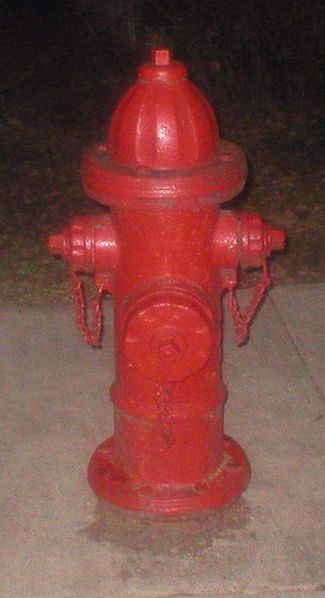
I had a question about a particular style of fire hydrant (Rensselaer, above). The hydrant itself is not one I have been able to operate or service. From what I have learned, the company that makes this style isn't in operation any more. I managed to find pictures and information you can access at Firehydrant.org here, the folks that operate this website have really done their homework. Most of the fire hydrant photos I have posted are from their website. I reccomend visiting FireHydrants.Org for any research into fire hydrants.

Wednesday, June 21, 2006

The Hagenbeck-Wallace Circus Train Wreck

Just before 4 a.m. 88 years ago tomorrow Hammond Indiana suffered one of its worst tragedies ever and the worst ever circus train wreck. It happened just beyond the city's eastern border in Ivanhoe, Indiana. The Hagenbeck-Wallace Circus train was parked on a rail siding waiting to switch over to a track that would take it into Hammond.

The train was scheduled to stop at Calumet Avenue and 150th Street to set up their tents and perform for the scores of children and adults expected to attend. The train was not clear of the Michigan Central Railroad line, which it had just turned off, and right behind it was an empty troop train heading from Kalamazoo to Chicago. The troop train engineer didn’t see the circus train blocking his right of way, because he had just fallen asleep at the throttle. It took very few minutes for the troop train to plow full steam, an estimated 60 mph into the parked circus train. Reports state that 86 of the 300 passengers on board the circus train were killed and 127 were injured. Many were charred beyond recognition. Kerosene lanterns, used to light the sleeper cars on the circus train caused fire to break out, which spread rapidly. Another contributing factor was that most of the Pullman cars were made of wood.

The scene, as with all disasters, drew large crowds of curious onlookers. The scene took several days to control and clean up. The Hagenbeck-Wallace Circus had to only cancel 2 performances. The one in Hammond and its next stop Monroe, Wisconsin. This was due in part by the assistance by many of its competitors, including Ringling Brothers and Barnum & Bailey Shows lending needed equipment and performers so that the show could go on. Many of the city's residents and shop keepers gave food and clothing as well.

June 22 1918 will be remembered in Hammond Indiana as a day of death and sorrow. The sight of the accident will be forever burned in the eyes of its townspeople. The information for this article came from the Hammond Historical Society. If you want to learn more you can contact the Hammond Historical Society for more.
Contact the:
Hammond Historical Society
564 State Street
Hammond, IN 46320 USA
Phone: (219) 931-5100

Monday, June 19, 2006

June Fire History

I have been taking a break from everything lately and have neglected my site. I haven't found anything I can post about the history of June 19th, so I decided to post on the month of June as a whole. I am only posting things I haven't posted on before and ones I think may be a little obscure or otherwise unknown to most.
Here is the partial list so far in order of event:

June 8 1783 the Laki Volcanic System in Iceland began erupting setting off a chain reaction of volcanic eruptions & leaving a dusty haze creating massive food shortages & the death of 9,350 people (mostly due to starvation) by February 1784
June 20, 1877 fire in St John NB Canada killed 100
June 20 1919 Mayguez Theater Fire in San Juan kills 150
June 19 1932 Hailstones kill 200 in the Hunan Province in China
June 5 1946 fire at LaSalle Hotel in Chicago killed 61
June 26 1957 category 4 Hurricane Audrey swept through Texas & Louisiana leaving 390 dead secondary to 12 foot storm surges that moved inland as far as 25 miles.
June 23 1959 fire at Resort Hotel in Stalheim Norway killed 34
June 1 1965 coal mine explosion killed 236 near Fukuoka Japan
June 6 1972 coal mine explosion killed 427 in Wankie Rhodesia
June 19 1972 Hurricane Agnes kills 118 in New York and Florida
June 24 1973 bar fire in New Orleans killed 32
June 30 1974 Discotheque fire kills 24 in Port Chester New York
June 9 1977 fire in nightclub in Abidjan, Ivory Coast
June 26 1977 Jailhouse fire in Columbia Tennessee killed 42
June 19 1980 saw a battle between police & demonstrators in Capetown leaving 34 dead
June 7 1997 Temple fire in Thanjavur India killed over 60
June 13 1997 movie theater fire in New Dehli India kills 60
June 30 1999 camp dormitory fire killed 23 in Hwasung South Korea
June 23 2000 hotel fire killed 15 in Queensland Australia

In doing the research for this post I learned a few facts on some of these events that I may post on in the future. If you have photos or information on any of these please feel free to contact me, I would love to include more.

The events I post on are generally ones that make widespread news and result in massive monetary and life loss. There are millions of events throughout history that effect the lives of people that make little or no great effect to the world as a whole but inflict terrible loss to the people effected. My site does not intend to show deminished respect to those people, only to highlight the highly technical and lengthy response of fire and emergency responders.

Tuesday, June 13, 2006

Hangin' at the station

The picture above was taken from a website showing pictures from the Atlanta Photojournalism contest. I can't remember the name of the young lady that took it. The picture shows FF Jimmy Jennings, Lt Gary LaPrad, Capt Riley Peters, and FF Willie Wines Sr from Roanoke City Fire EMS Department in Roanoke City Virginia in front of Fire Station 1.

Recently I was returning in my apparatus from our central service center after much needed repairs when I passed another one of our stations. The station is in one of the worst neighborhoods in the city filled with gangs, violence, and system abusers in an EMS sense. The guys at #9 stay on the go most days. This particular day I noted that all 5 of the guys on duty this day were sitting in front of the house relaxing and talking.

This sight spawned a thought process. How often do we just sit out front and hang out talking about.... whatever. The old days that everyone often tout as so grand are made so by the friendships and fondness for each other that we share. None of us have the time to sit and 'chew the fat' with each other like we used to, but we should make an effort to keep the spirit of brotherhood and the station spirits high.

I think this is an important part of history. After all, the fire service 'Band of Brothers' is a real group and it exists in each and every department and we all need to just relax and hang out.

The national stand down is approaching quickly (June 21) so my challenge is this: Take the day slow and appreciate the break from training and all the other stuff your departments send your way and get the guys together and pull some chairs out in front of the station and just hang out. Watch the cars, the people, the sky, or whatever you want and just chat it up with your station-mates, and watch the bonding taking place before your eyes.

Tuesday, June 06, 2006

Oklahoma City Memorial Pictures

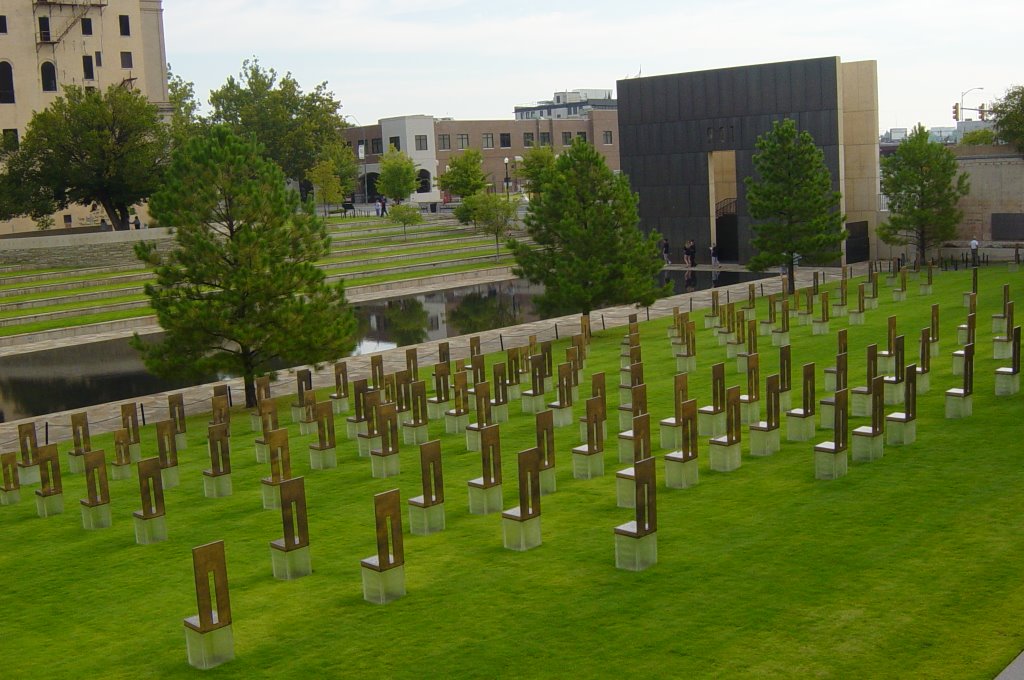
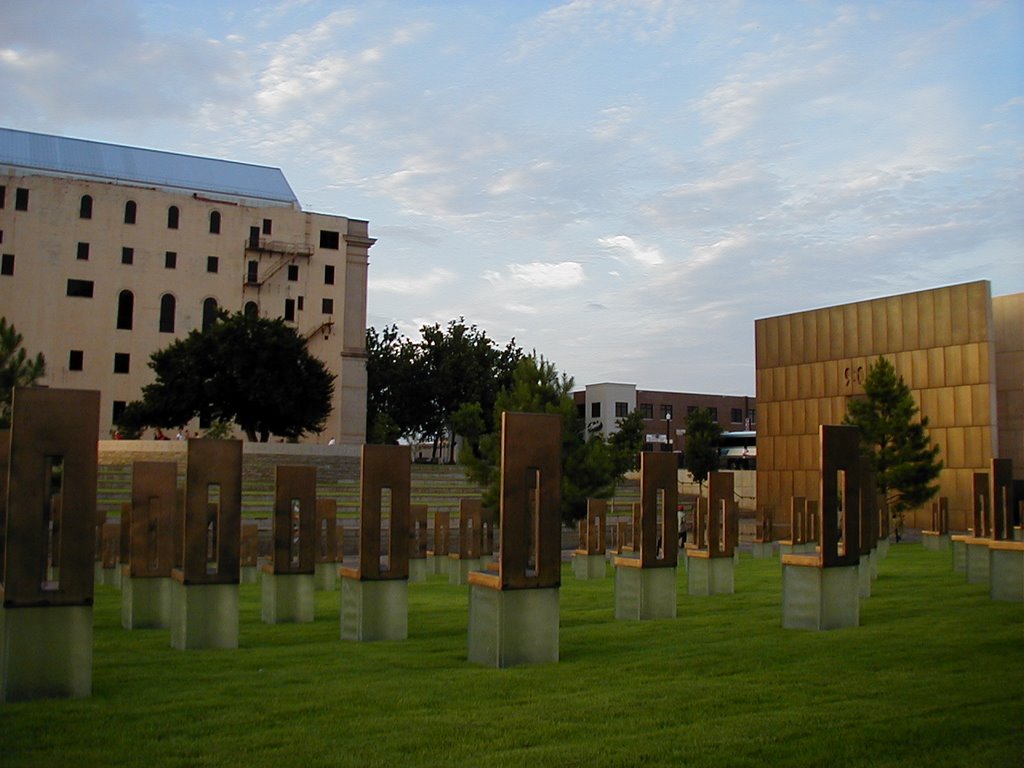
Roanokefire.Com sent links to these photos of the memorial. As you can see there are 168 chairs facing the reflecting pool and a large monument to the victims. It also appears that each chair is lighted at night. I have never been to the memorial, but from the pictures it is moving.


All of these photos come from

Monday, June 05, 2006

Alfred P Murrah Building

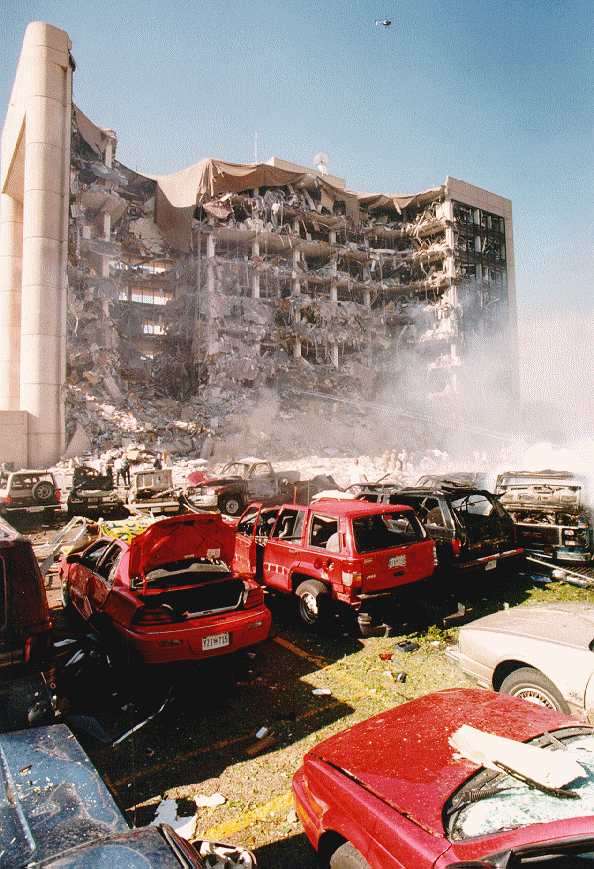
Photo courtesy of the Oklahoma Publishing Company (OPUBCO) http://www.newsok.com/At 902 AM on April 19 1995 a tremendous explosion rocked the foundations of America and played havoc with the residents of Oklahoma City. A rental truck with the sole and evil intent to kill and wound was driven to this building and parked intentionally on the side that a child care center was housed and detonated. The result, 168 deaths and over 490 injuries. Among the dead were 19 young children that had their lives stolen from them and the lives of their siblings and friends forever altered. The response to this event was enormous, bringing responders from across the country.

Recently, I was able to attend a class with a Captain from Fairfax County (VA) Fire Department who happened to respond with the task force to this incident. I didn't pry, even though I was interested, about the response and what he saw. He did speak of the unforgetable sights of devastation and tragic loss of life he saw. The scene was huge and chaotic, even after it was organized. He did tell me of the Oklahoma Firefighters that were on scene with him. He spoke highly of the men and women that took the event in stride and managed to live through this tragic event and operate in extreme conditions that most departments would crumble under.

He told me of men that would pull a 24 hour shift on duty then report to the site and pull 16 hours digging through the rubble, then go home for 6-7 hours and report back to work for 24 more hours. The Pyschological stress of the initial response alone should have crippled the department and the physical strain on manpower had to be overwhelming, but somehow the department and its membership managed to survive and mitigate the situation quickly and in an effective fashion.

Please visit the memorial site here and you can view Oklahoma City FD here

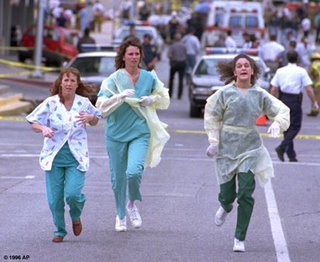
Here is a page dedicated to the investigation. Oklahoma City fire Capt. Chris Fields carries 1-year-old Baylee Almon (who later died as a result of her injuries), injured in the bombing at the Alfred Murrah Federal Building in downtown Oklahoma City on April 19, 1995. This photo was awarded the Pulitzer Prize for photographer Charles H. Porter IV. The massive response to the bombing and support services on scene Unidentified rescuer taking a break with his K9. After a report of another possible bomb staff from hospital retreat to a safer location
There is a very nice memorial with a reflecting pond and 168 seats that provides the families of the victims a place to mourn on the site of the building. I haven't been able to find a picture of it for this post, but if I do I will post it.

Wednesday, May 31, 2006

EMS Memorial Service

Every year, as I have pointed out in the previous post, there are multiple line of duty deaths in public safety. The EMS sector has it's share as well as the fire service and police divisions around the world. The National EMS Memorial service was this past weekend in Roanoke, Virginia. An annual EMS Memorial bike ride to raise awareness and support of the fallen was held ending at the service in Roanoke. NAEMT has a daily log of one of the bike riders posted on its website and also shows alot of other ongoing events you might find interesting. The service is hosted and housed in the 'To the Rescue Museum' in Roanoke. Currently, To the Rescue has no home, they are running low on funds and can no longer afford to pay the rent at the mall they were housed in. I know my site is about fire history, but I think EMS is as much a part of fire history as Dry Chemical extinguishers (not ancient, but a part neverless). We are all brothers and sisters regardless of our training or status (Fire/EMS - paid, volunteer, or combo), our goal is to protect and serve the citizens of our areas.

If you get a chance to check out the exhibits of To the Rescue online Here and if you are able drop them a donation, no matter the size. I would hate to see the exhibits fall into disrepair and never be seen again. The memorial tree needs to be kept on display to honor the fallen EMS workers across the country that are posted on it.

"Remember those who went before us and all who sacrifice every day for the benefit of the public’s health." NAEMT Board member and ride participant Jennifer Frenette (from NAEMT.Org).

Monday, May 29, 2006

Fallen Firefighter Memorial


On memorial day I thought I would post a simple picture of the National Fallen Firefighter Memorial and a link to the USFA National Fallen Firefighter Memorial webpage. Please pay your respects.

Saturday, May 27, 2006

Memorial Day

Every year there are around 100 Line of Duty Deaths in the fire service. I know several EMS workers die each year but I cannot qoute an average. These folks need to be in our thoughts, but this weekend is about remembering the men and women who have sacrificed their lives in service of our country and our people. One stat that isn't kept is how many are active firefighters, EMS workers, and police officers. I know of several in my department that serve in the National Gaurd/Reserves and I'm sure there are hundreds across the country in other departments. Take one quick minute this weekend to think about the folks that aren't awarded the LODD benifits and that aren't recognized as firemen when they die in military service. These folks don't deserve more respect or rememberance than the other men and women do, they just hit closeer to home.

Tuesday, May 23, 2006

More Fire Hydrants


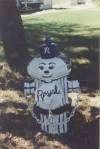
Thought I would throw out some more pictures of the fire hydrants that I have found. These aren't as traditional though, I figured that I could show some of the more humorous ones. They are from several different locations and sources, I can't qoute which ones they are from.

Saturday, May 20, 2006

Lake View School Fire


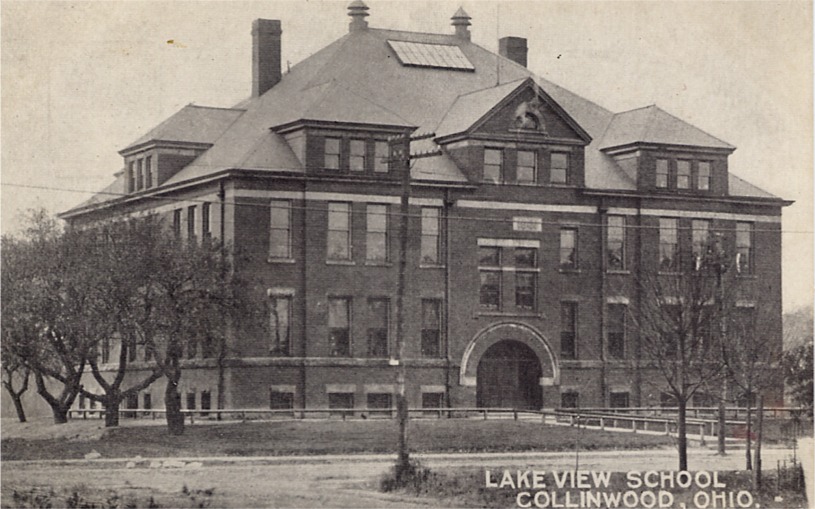
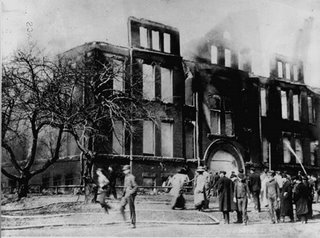
On Ash Wednesday March 4, 1908, the 63rd day of the year the Lake View School in Collinwood Ohio experienced a massive fire that ended in the destruction of the town’s school and the death of 172 students, 2 teachers, and a rescuer. The photo above is one of the school prior to the fire and the one at the end of this post is of the school after the fire. To date this was the deadliest fire of this type in recorded US history.

The Lake View School was built with load bearing masonary outer walls, but much of the four story building’s floor structure system used wood joists. The fire started in a wooden joist that caught fire when a steam pipe caused it to be overheated. The main stair case extended from the front doors of the building to the third floor; without fire doors, the stairwell acted like a chimney and caused the fire to spread quickly. Oiled wooden hall and classroom floors also helped to fuel the fire. It was believed that those killed were trapped by the building's vestibule doors, which opened inward, not outward. Doors to the building were equipped with common door knob latches, not modern crash bar latches. Panic caused a large number of students in stairwell vestibules to be crushed which contributed to the death toll, some also died from smoke inhalation and direct fire burns. Some children died as they jumped from 2nd and 3rd story windows. People watched as victims that were trapped in the building were burned beyond recognition.

The aftermath of the fire saw the advent of a mass grave site due to the inability to identify the remains of some of the children and some people being unable to afford burial. Some of the parents of children chose to bury their children alongside their peers. This mass grave was constructed in Lakeview Cemetary in Cleveland. After the fire the remains of the building was razed and memorial gardens were constructed on the grounds of the new school.

The effects of this fire reached all across the Unites States and helped to establish safer schools for our children today. The events at this school and others such as the Our Lady of Angels School fire shaped the future.

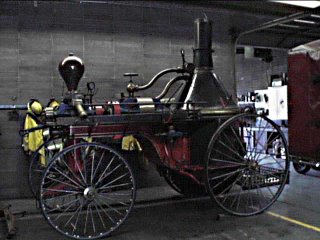
Silsby Steam Fire Engine


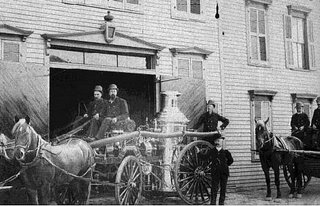
Silsby Manufacturing Company desgined and built their first Steam Fire Engine in 1856. The company was founded in 1845 running through 1890. Their first engine weighed 10,000 pounds and was a marvel of the day. Over the course of steam engine history no other company manufactured more steam operated fire engines than Silsby. Producing well over 1,000 steam powered fire engines Silsby introduced original and effective technology into the production of steam engines that was challenged by the constructors of the day. The Silsby machines went through 9 model changes and have several dozen still around today. You can go to the Silsby website Here The website has links to parts directories and lists of existing steam engines. They also have photos (which is where all of the photos I have posted are from)

The machines that Silsby have produced are remarkable in their endurance and design.

Thursday, May 18, 2006

Fire Hydrants, Fire Plugs, and Johnny Pumps


The guys at my station started discussing our hydrants and water supply and it eventually spread to a history lesson. Some of the history I knew, some I had to research. Before there were municipal water systems fighting fire with water took some strategy. In China, firefighting cauldrons were used to store water in locations around the cities and during outbreaks of fire people would carry their buckets to the cauldron and dip out water to use for firefighting. The municipal water system debuted and resembled a faucet, from which the old bucket brigade method would operate, filling the buckets and shuttling them to the fire. This system was used as a public water supply, until fire broke out. In the colonial era fire cisterns, large underground tanks or structures, were employed to hold water to be pumped for fighting fires. One source notes that Louisville, KY employed 124 cisterns and no hydrants, and some cities still have operating fire cisterns.


The term ‘fire plug’ is a colloquial for fire hydrant, as is ‘johnny pump’. The origin of the fire plug is from the 1600s. During this time responding firefighters, upon arrival at a fire scene would dig up the existing water main and drill/bore/smash a hole into it for the purpose of securing water for firefighting operations. This was utilized via bucket brigades and later hand operated fire pumps. After the firefighting operations were finished the holes were plugged with stoppers that eventually became known as fire plugs which is how fire hydrants eventually became known as fire plugs. London, in 1666, experienced the “great fire of London” and afterwards installed water mains with predrilled holes at given intervals and risers and they installed plugs at the street level to reduce the time it took to get water.

The inventor of the fire hydrant system is a mystery. There have been several people credited with innovations regarding hydrants. Hydrants come in many sizes, shapes, and colors. In our area, as with most, our hydrants are color coded (Blue, Green, Yellow/Orange, and Red in descending GPM rates) to help identify the amount of available water. There are several underground variations at places like airports. In the UK hydrants are located in the ground and have yellow ‘H’ signs to indicate the location for firefighters. In Finland they use a similar system, only their signs are blue. The signs (or other signs nearby) also note 2 numbers which indicates the size of the water main in millimeters (a top number) and the distance it is from the hydrant (the bottom number). Some of the older signs may express the numbers in Imperial Units.

I have found several styles of hydrants from around the world. There are many different colors and shapes of each type. I have listed as many as I can find below. There is a link to a great information site on the right and it has links to information pages for each of the listed copanies. This site has a wealth of information that I can’t give enough justice to.

American Darling Valve
American Foundry and Mfg. Co
American Valve & Hydrant
American AVK Company
AVK
H.W. Clark Co (Illinos)
Barbará (Brazil)
Bayard
Clow Canada
Clow Valve CorpCulan Slan Iron Works
Danfoss Esco AS (Norway)
East Jordan Iron Works (EJIW) (Michigan)
Eddy Valve Co.
Elkhart Brass Mfg Co
Eisenwerk Rödinghausen (Germany)
Erhard (Germany)
FUMOSAC (Peru)
Fumosa (Peru)Fundición Gamboa (Mexico)
James Jones Co. (California)
J.J.N. Ltda. (Columbia)John Fox & Co – NYC
Karya Puyasa (Indonesia)
Kennedy Valve (New York)
Kitagawa Iron Works Co., Ltd. (Japan)
Knowsley SK, LTD (UK)
Kupferle Foundry (Missouri)
Ludlow-Rensselaer (Ohio)
M&H Valve & Fitting Co. (Alabama)Gould HydrantGratz-Bohm
E. Hawle & Co Armaturenwerke (Austria)Hays Mfg. Co. - Erie, PA J.H.Heathman - LondonHinman Hydraulic Mfg (Colorado)Ideal Hydrants and StreetwashersC. M. Kemp Iron and Wood Case HydrantsShand Mason & Co - UK McKim Foundry & Machine Co (New York)
McNamara Pattern HydrantsMerryweather - London, UKModern Iron Works - Quincy, ILMonarch Forge & Machine Works (Oregon)Mueller (Alabama)
A.J. Morse and SonNapa Pump and Mfg CoPacific Tank & Pipe Co (Oregon)Pittsburgh Filter Mfg Co (Pennsylvania)
Plueger & Henger Mfg. CoSomerville & Leitch - Washington, DC
Saint-Gobain CanalizaçãoT & S
Maezawa (Japan)Tibb
Thomas McAvity & CompanyWaterworks Equipment Co – NYC
Mittelmann Armaturen (Germany)
Mueller Canada Canada Valve Ltd.Canada Valve and Hydrant Co. Ltd.Dominion Steel Products Company (Canada)
Murdock, Inc. (Ohio)
Olympic Foundry Company (Washington)
Penn-Troy Machine Corp. (Pennsylvania)
Pont-à-Mousson (France)
Raphael Valves Industries Ltd. (Israel)
Saint-Gobain PAM (France)
De Sanno Industries
Service Brass
Desco
Shilla Fire Co., Ltd. (Korea)
Terminal City Iron Works ACS Inc (Canada)
Universal Flow Engineering (Canada)
US Pipe and Foundry (Tennessee)
VAG-Armaturen GmbH (Germany)
Bopp & Reuther GmbH (Germany)
Vazhod J.S.C. (Bulgaria)
Von Roll (Switzerland)
Waterous Engine Works Co., Ltd (Minnesota)Waterous Company (Minnesota)
Yokoi Mfg. Ltd. (Japan)
ZET Marketing & Trade (Japan)
Glenfield & Kennedy, Ltd. (Scotland)
Ham Baker & Co. Limited (England)
Johnson City Foundry & Machine Works, Inc. (Tennessee)
Cayuta Wheel and Foundry Company (Pennsylvania)National Car Wheel Company (Pennsylvania)
Ramsay's Machine Works (Canada)
Tamaqua Mfg. Co. (Pennsylvania)
Wolff & Zwicker Iron Works (Oregon)
Windsor Foundry (Nova Scotia)
The Vulcan (Canada)
Utica Pipe Foundry Company (New York)
J. Tylor & Sons (England)Tylors of London (England)Tylors (Water & Sanitary) Limited (England)Tylors (Division of Crane) (England)Crane, Tylors Division (England)
Three Rivers Iron Works (Canada)

Some of these companies are the results of mergers and renaming efforts of the existing companies. There are definitely more companies that make hydrants but I haven’t found their names yet. If you know of more feel free to drop me a line and I will add them to my list. A picture from Eygpt (I think) showing the old 'faucet' style hydrants
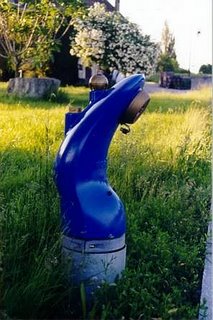
I don't know the ake of this hydrant but it is different
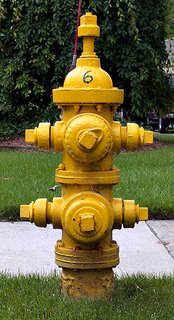
I hope whoever this hydrant belongs to has a strong main attached to it with that many connections

Artist rendering of working fire with the firemen using a flip top style hydrant
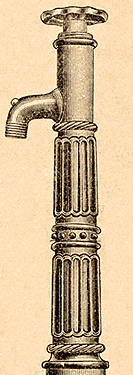
Drawing of an old 'faucet' type hydrant

Cauldron (from China) used for bucket brigades
Tuesday, May 16, 2006

2 events on this date


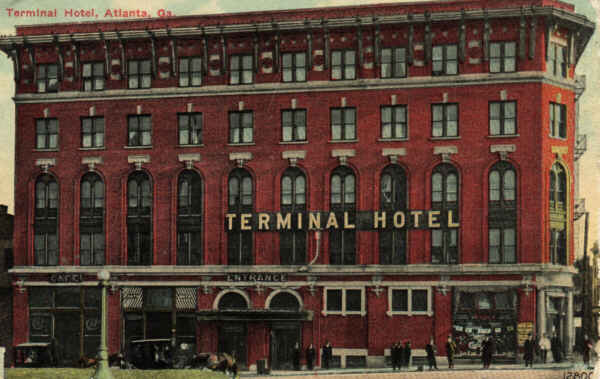
May 16 is the date of 2 noteworthy events. The first is the 1st recorded dam disaster in U.S. is caused by a landslide collapsing a 43 foot high earthen dam above Williamsburg, Mass. The other is the Terminal Hotel Fire of 1938 in Atlanta GA that killed 38 people. The details of both of these events are sketchy at best for me. The picture above is the Terminal Hotel which was built in 1908. Of the dead, most were railroad men that were waiting on the morning train. If there are more pictures or details that you can give me, I will gladly add them to my posting.

The picture above is from: "Atlanta and Environs, A Chronicle of Its People and Events, Vol II" by Franklin M. Garrett, ©1954 by Lewis Historical Publishing Company, Inc., Rep 1969 by University of Georgia Press.

Sunday, May 14, 2006

More extinguishers

Soda Acid extinguishers are covered below. But while thinking about them I decided to post a few pictures of other styles of extinguishers. The history of fire exinguishers is varied. As you can tell by the photos here there are many styles and many methods of operation. There are links on the right for an extinguisher museum and I will be adding more links, photos, and information on this subject later on. enjoy the pictures.

Standard Water Extinguisher


This is a Pyrene Fire extinguisher showing in closed and open positions. This was manufactured in NYC. They are run by Kiddie Corp. which falls under Angus Fire. This particular extinguisher was manufactured in the early 1900s. The chemical used to put out fires was Benzo(def)phenanthrene and -pyrene, known in this use as Pyrene. The chemical itself is a polycyclic aromatic hydrocarbon (PAH) which is derived from coal tar. It is a neurotoxin, skin and sense toxin as well as having carcenogenic properties. The extinguisher is made of brass and is about a foot long and 4 inches in diamter. I am not sure exactly the nature of the manufacture of the chemicals or what relation the current owners had to the original production of these extinguishers. All of the chemical information I have posted is gleaned from another website.


This little extinguisher is a Presto "C B" extinguisher. It uses Chlorobromomethane to extinguish fires. It uses a small twisting knob to discharge the chemical to smother the fire. Merolite Industries from NYC made this. The extinguisher is made of brass and is around 5 inches long with a diameter of about 1 1/4 inches.


This is a Liberty Fire Extinguisher. It was made in Wawanesa, Manitoba, Canada for the Wawanesa Mutual Insurance Company. It lists that is contains a dry chemical in it, but I cannot find out what chemical it had in it. The extinguisher is about 1 1/2 feet long and around 2 inches in diameter, and has a pull tab at one end, which I assume is to activate the discharge.

Saturday, May 13, 2006

Soda Acid Fire Extinguishers


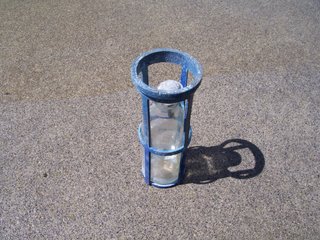
Several people have asked me about these extinguishers. The Soda Acid extinguisher was the hottest thing going at the time of its emergence. The problem was that you were using acid that reacted with other chemicals to fight fire. This is crazy by today’s standards but then it was the best thing on the market. The process was simple you filled the barrel of the canister with the soda, then a glass bottle with the acid, placed a lead 'stopper' on top of it the screwed on the lid and hung it on a wall to wait for someone to come along and use it. When a fire broke out someone would remove the extinguisher from its bracket and turn it upside down to grasp the handle. The upside down action would cause the lead stopper to fall from the bottle releasing the acid into the soda for mixing causing it to expand and discharge from a rubber hose attached to the side. In the normal fashion a sweeping motion would be used to cover the fire with the solution smothering it out.

There were several variations of these extinguishers including miniature versions. Mostly they were constructed of brass, but could be found in stainless steel variations towards the end of their use. People have wondered how to restore one of these historical extinguishers. My advice it to pay someone that knows how to restore antique brass, because the process is long and can go very wrong if you aren't careful. Most people have (and I myself have used this technique, and it works) gathered the brass parts and placed them into a large watertight container. The next step is to get a large amount of vinegar, enough to completely cover the brass, and fill the container just enough to cover the brass parts.

Depending on the condition of the brass the soaking required could take anywhere from hours to days. But, eventually the vinegar will cut the crude off of the brass and restore a semi-luster to the brass. After the vinegar has been wiped from the brass, use Brasso or some other marketed polishing agent to put a shine on it.

The only problem with this process is that eventually the dull nature of brass from being exposed to air will return unless you seal it. This is the problem that people run into. If you apply the sealant or glaze incorrectly you will ruin the brass, as it is very hard to remove even with chemicals which will permanently alter the brass's shine, this is why I suggest using a professional. If done right, this will be the best-looking extinguisher around, if done wrong, it's scrap.

Posted above are photos of some of my Soda Acid extinguishers in varying stages of restoration, one of which you can see is in need of a good polishing. There is a series of shots showing the Bottle, the Carriage for the bottle, the plug, and the handle to help show the workings of the extinguisher.